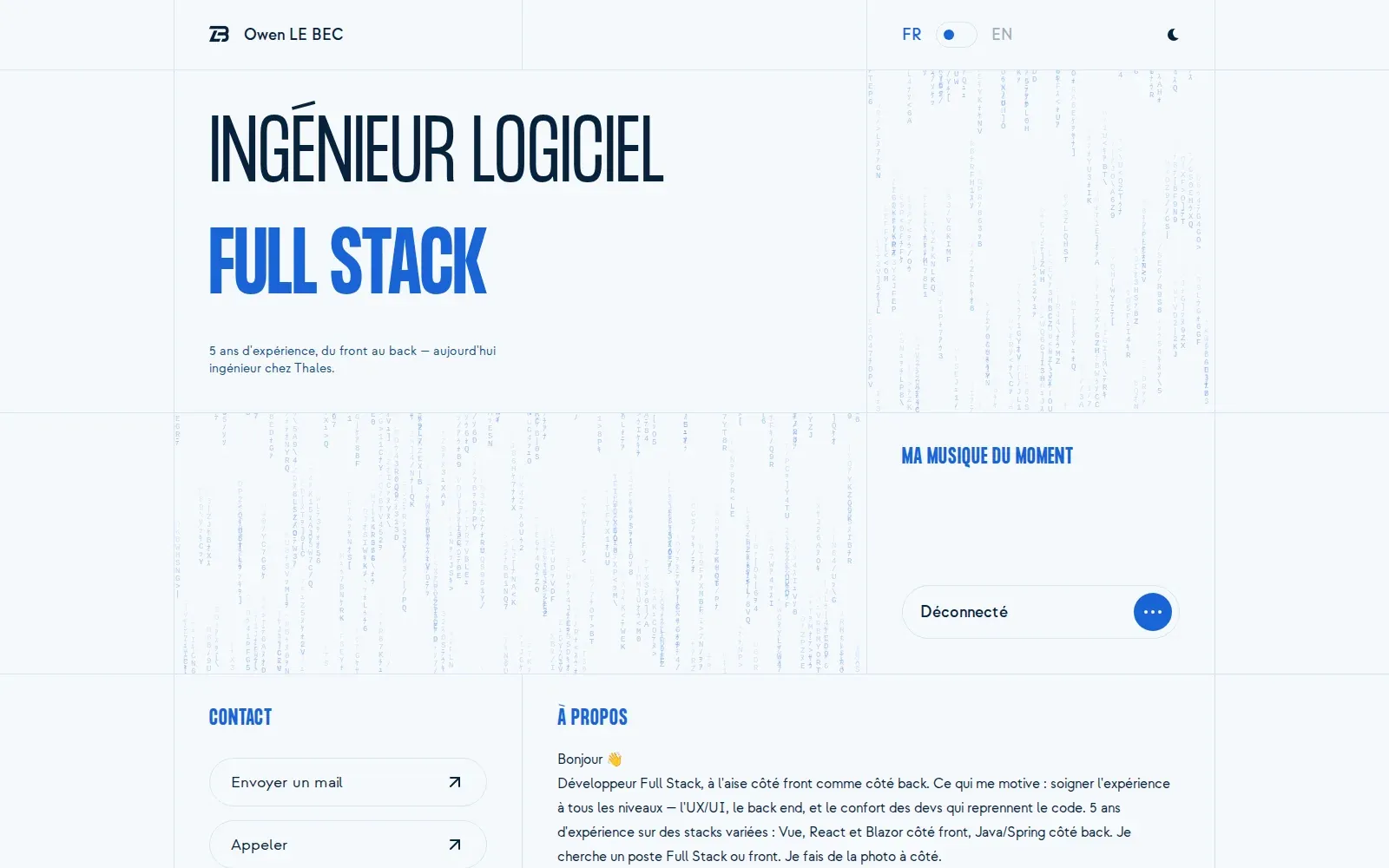
Developer Portfolio
DETAILS
Bilingual portfolio built with Nuxt 3 in SSR + static prerendering — per-URL bilingual (FR / EN), Markdown content, live Spotify integration and CSS-only page transitions.
Git RepositorySTACK
- Nuxt 3
- TypeScript
- @nuxt/content
- @nuxt/image
- @nuxtjs/i18n
- @nuxtjs/sitemap
- Netlify
The very site you're reading right now — bilingual by URL, statically prerendered, and built for SEO and accessibility alike.
What's the context behind this portfolio?
Personal portfolio covering projects, work experience, and contact information. The site is bilingual by URL (FR at /, EN under /en/…), embeds a live Spotify integration to display the currently playing track, and is deployed on Netlify with SSR + static prerendering (every page of both languages is generated at build time, with hreflang and canonical tags). The Spotify API route runs as a Netlify Edge Function (Deno).
What's the tech stack?
- Nuxt 3 (
ssr: true+ prerendering) — the build prerenders every route of both languages to full HTML (nitro.prerender.crawlLinks), served statically by Netlify then hydrated client-side. The HTML carries content, OG meta and JSON-LD on first paint (LCP + indexability), with no Node server at runtime. - @nuxt/content v2 — all content in Markdown with TypeScript-typed frontmatter. No database, no REST API —
.mdfiles are the source of truth, queried withqueryContent(). Note: content_pathvalues have no locale prefix (/projects/finixa), so queries target the slug rather thanroute.path(which is/en-prefixed in English). - URL-based i18n (
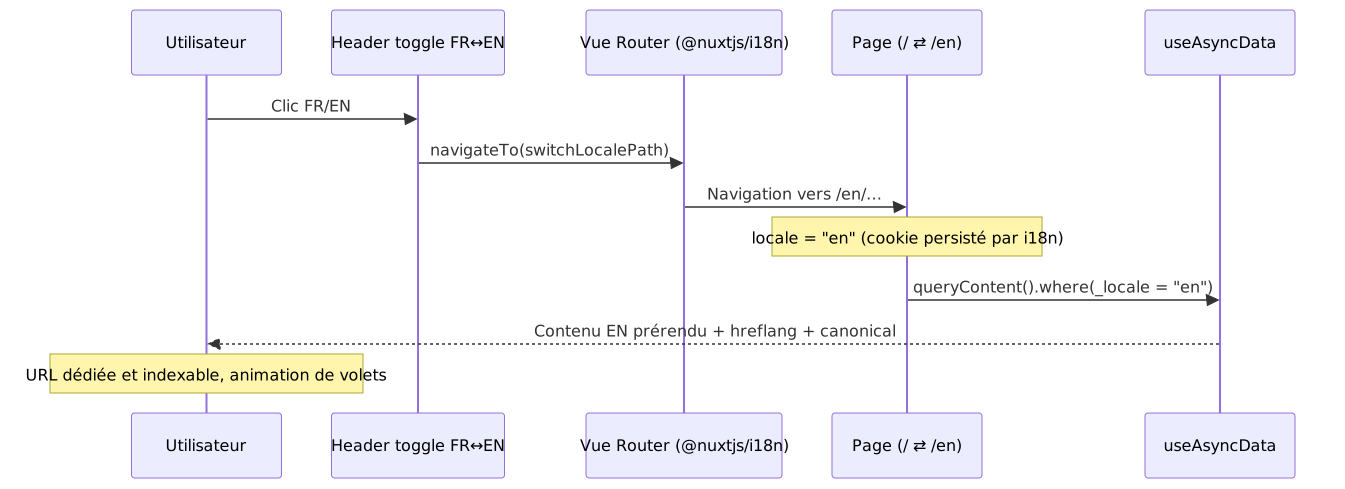
@nuxtjs/i18n,prefix_except_default) — FR at/, EN under/en/…, each language with its own crawlable URL. Per-localehreflang+ canonical viauseLocaleHead(), with thelangcookie kept for the visitor's preference. Switching language is a navigation (switchLocalePath()) — the blind animation is played by the page transition.queryContentqueries filter by_locale. - Auto sitemap (
@nuxtjs/sitemap) —/sitemap.xmlis a per-locale index (fr-FR.xml+en-US.xml) generated from the prerendered routes, fed by the canonical site URL (site.url). - SCSS without a CSS framework — custom design system:
space($n)function (=n × 4px),transition()mixin, CSS custom properties for light/dark theming (--primary,--background,--accent,--text). - @nuxt/image with Netlify provider — project cover images (
.webp) are served through the Netlify CDN with on-the-fly resizing at delivery. - Git LFS —
.webpfiles are tracked via.gitattributesto avoid storing large binaries in git history. - Netlify Edge Function (Deno) —
netlify/edge-functions/spotify.tsserves the/api/spotifyroute. Exchanges a refresh token for an access token on every request, without storing tokens or exposing credentials client-side. - Umami Analytics — async script loaded via
useHead, no cookies, no personal data sent to third parties.
Notable technical points
- CSS Grid with
display: contents: the main grid is defined on.page(4–5 columns).AppHeaderandAppSectionusedisplay: contents, making their child cells direct participants of the parent grid regardless of depth in the Vue component tree. Editorial layout without wrapper noise — butdisplay: contentsremoves elements from the accessibility tree, requiring explicit ARIA handling on affected components. - CSS-only page transitions: transitions use the
.cell:beforepseudo-element positioned off-screen by default (inset: -1px calc(100% + 1px) -1px -1px). The.page-leave-toclass slides it over the full cell, creating coordinated blind-closing effects. Zero JavaScript — only Nuxt page transition hooks + CSS. Cleanly disabled viaprefers-reduced-motion. - Slug validation middleware:
middleware/project.tsruns aqueryContent()before rendering the project page. If the slug doesn't exist,abortNavigation()is called — navigation is cancelled cleanly instead of rendering an empty page. The check is locale-agnostic (projects exist in both FR and EN), which keeps the middleware out of the i18n lifecycle. - Inlined SVGs for diagrams:
ProseImg.vuedetects.svgimages and fetches them viauseFetchto inject as raw HTML inside a.svg-wrapper. Diagrams are therefore themable via CSS — hence the explicitfill,strokeandcoloroverrides on internal SVG elements in[slug].vuefor dark mode. - Stagger animation via IntersectionObserver: the project list animates with an
IntersectionObserver(threshold 0.15). Each project link gets atransitionDelaycalculated from its index (index × 400ms), producing the staggered entrance without an animation library.
What I learned
Designing a CSS Grid layout that flows through multiple Vue component levels via display: contents requires a precise understanding of its accessibility tree impact: elements with display: contents are transparent to the visual DOM but not to screen readers. The CSS-only page transition required several iterations of timing to coordinate the old component's exit with the new one's entrance without a flash of content in between.
Diagrams
Global architecture

Reactive i18n system
CSS Grid layout structure
